Jeep Cherokee XJ Buyer’s Guide: The 4.0 Years Worth Buying
This article contains affiliate links. If you buy through one, Basic Rigs may earn a commission at no extra cost to you. As an Amazon Associate we earn from qualifying purchases. Full disclosure.
If you want one SUV that passes every point of our simplicity test, start with the Jeep Cherokee XJ and the 4.0-liter inline six.
It is boxy, light, easy to work on and supported by every parts store in the country. The trick is buying the right years and walking away from the wrong examples. Here is how.
The short answer: which years to buy
- Best overall: 1997 to 1999. You get the 1997 refresh (new interior with dual airbags, a steel liftgate instead of the old fiberglass one, and a stiffer body) and the proven Aisin AX-15 manual or AW4 automatic, without the cylinder head worries of the last two years.
- Good, with a check: 2000 to 2001. These have coil-on-plug ignition and the NV3550 manual. They also carry the cylinder head with the worst cracking reputation, so check the cooling system history closely.
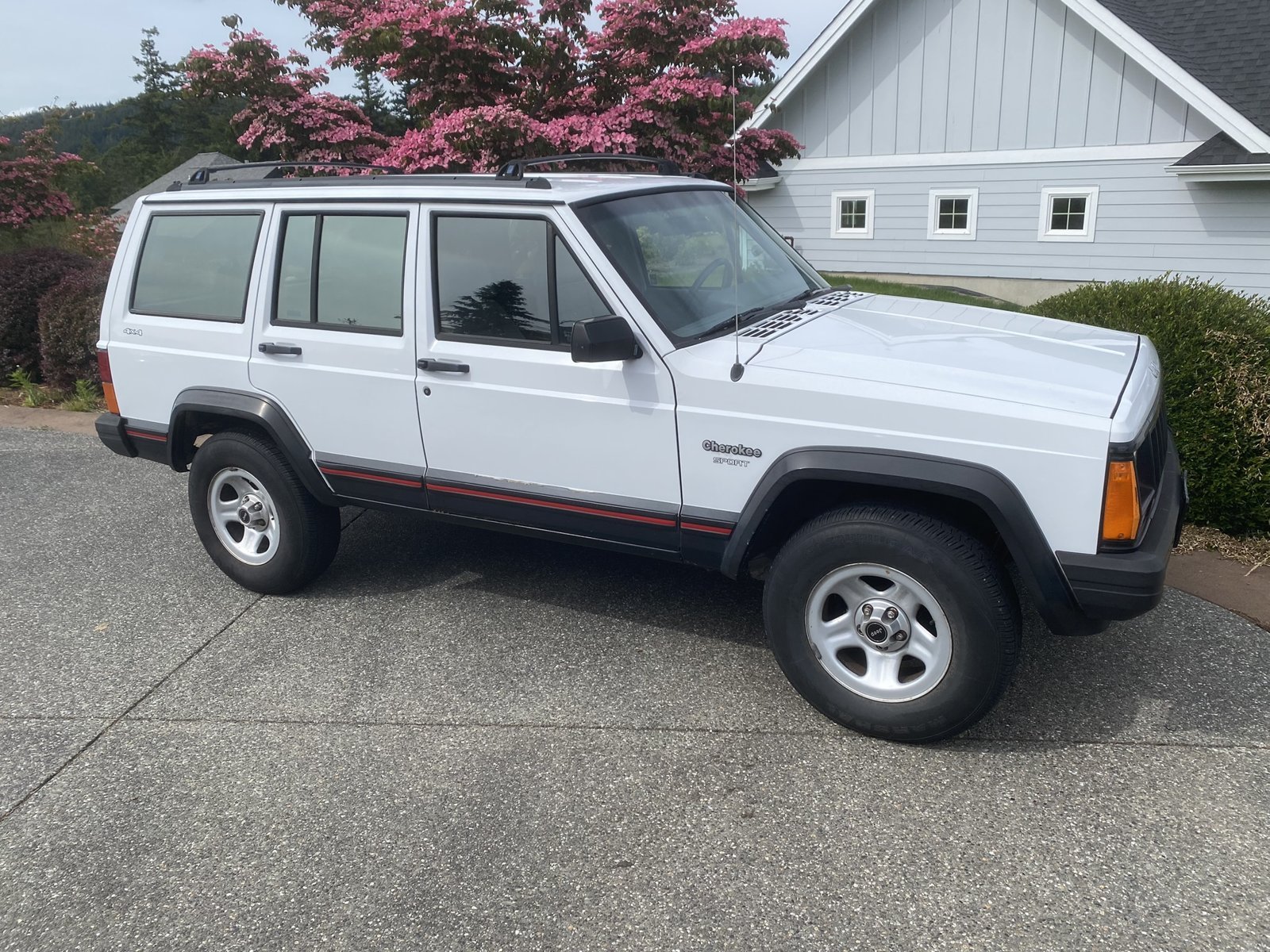
- Fine for the right buyer: 1991 to 1996. The 190-horsepower “High Output” 4.0 and fault codes you can read. Older interior, fiberglass liftgate, and early-1990s fuel injectors that are prone to leaks. Our own 1993 Cherokee Sport, pictured above, sits in this group.
- Skip unless it is cheap and clean: 1987 to 1990. The 4.0 is there, but the earlier Renix engine management is harder to diagnose and cannot store fault codes.
Sources: Wikipedia, Quadratec, SlashGear, Driving Line.
The engine that makes the XJ
The XJ was sold in the United States for the 1984 through 2001 model years. Early trucks used a 2.5-liter four or a Chevrolet-sourced 2.8-liter V6. The engine that made the XJ’s reputation arrived for 1987: AMC’s 4.0-liter inline six (Wikipedia).
For 1991, Jeep moved the 4.0 to Chrysler engine management, revised the exhaust manifold and badged it “High Output,” rated at 190 horsepower and 225 lb-ft. That is the version most buyers want. It is not fast by today’s standards. It is strong at low speed and simple to service.
Transmissions
- Peugeot BA-10/5 manual, 1987 to mid-1989. The weak link of the bunch. Avoid unless you plan to swap it.
- Aisin AX-15 manual, late 1989 to 1999. The one most owners want.
- NV3550 manual, 2000 to 2001. A solid replacement for the AX-15.
- AW4 four-speed automatic, 1987 to 2001. Durable if the fluid has been changed. Ask for records.
Transmission dates from Wikipedia and Offroaders.com.
What fails, and what it takes to fix
Every XJ for sale is 25 to 40 years old. These are the problems you will find, roughly in order of how often you find them.
- Overheating. XJs have a reputation for cooling trouble. The usual suspects are the radiator, fan clutch, thermostat, hoses and water pump, all driveway jobs (Off Road Xtreme). Fix the cooling system first. Overheating is what cracks cylinder heads.
- Oil leaks. The rear main seal, oil pan, valve cover and oil filter adapter all weep with age. Check the cheap oil filter adapter seal first. The rear main is a two-piece seal you can replace without pulling the transmission (Off Road Xtreme).
- Cracked exhaust manifold. A ticking sound at cold start is the giveaway. Replacement 4.0 manifolds and headers are easy to find on eBay Motors. Worn motor mounts make it worse, so replace those too (Off Road Xtreme).
- Death wobble. A violent shake after a bump at highway speed, usually traced to a worn track bar. Vague steering is often just a tired steering stabilizer, a cheap and easy fix (Octane).
- Cylinder head cracks on 2000 to 2001 models. The head used in the last years has a reputation for cracking, usually after an overheat. Warning signs are coolant loss with no visible leak and bubbles in the coolant. Owners disagree on exactly when the improved replacement head arrived, so treat any 2000 or 2001 with an unknown cooling history with caution.
- Hot stalling or a no-start. Often a failing crankshaft position sensor, an inexpensive part you can swap in the driveway.
Rust: the deal-breaker
Mechanical problems on an XJ are cheap. Rust is not. The XJ has a unibody, so the frame rails are part of the body (Octane).
- Get under it with a flashlight and a screwdriver. Probe the frame rails, especially near the suspension mounts. Soft or flaking rails mean walk away.
- Check the rocker panels and the lower rear quarters.
- Pull back the carpet and look at the floor pans. Floors are fixable with patch panels. Rails are a much bigger job.
A truck from the dry West with soft rails is still a bad buy. A truck from the Rust Belt with solid rails can be a good one. Inspect the actual truck.
Recalls
Run the VIN at NHTSA.gov/recalls before you buy. Recalls on these trucks are 20 or more years old, but you want to know whether the work was done, especially on 1997 to 1999 airbag control modules and mid-1990s front brake rotors.
What one costs
Prices swing widely with rust, mileage and modifications. As of October 26, 2026, classic.com shows most 1997 to 2001 XJs listed between about $6,000 and $15,000. Its sold results for 1999 models ran from $2,400 to $38,000, with most well under $15,000. A clean, rust-free, stock example with records sits at the top of the range. A tired driver with a cracked manifold sits at the bottom.
Budget at least $1,000 beyond the purchase price for a cooling system refresh, fluids and whatever leaks you find. That is the real entry price.
The inspection checklist
- Cold start: listen for an exhaust tick and look for blue smoke.
- Temperature gauge: it should sit steady in the middle on a 20-minute drive, including at idle.
- Under the truck: frame rails, floor pans, rockers, and fresh oil on the bell housing or pan.
- Steering: drive over a bump at highway speed and feel for shake.
- Codes: on 1996 and newer, plug in an OBD-II reader. On 1991 to 1995, use the key-cycle method in the service manual.
- Paperwork: receipts for the cooling system and transmission fluid are worth money.
Verdict against the simplicity test
- Diagnose it yourself: pass on 1991 and newer.
- Hand tools: pass. Nearly every common repair is a driveway job.
- Parts: pass. New, used and aftermarket parts are everywhere.
- No screens: pass.
- Daily driver: pass, if the cooling system and rust check out.
The XJ is about as close to the ideal basic rig as an SUV gets. Buy the best body you can afford, fix the cooling system first, and keep a service manual in the glove box.